
Frame
Define the intelligence question, decision relevance, scope, and the distinction the assessment must resolve.
AAD turns structured holdings into reviewed intelligence products. It is designed to keep collection, assessment, approval, and publication distinct—and to refuse claims the evidence does not carry.
AAD does not collect independently or create the evidence used to clear its own products. Analysts author judgments against structured holdings, record assumptions and alternatives, and route products through defined review gates.
Define the intelligence question, decision relevance, scope, and the distinction the assessment must resolve.
State key judgments with confidence, reasoning type, assumptions, and explicit alternatives.
Evaluate source structure and independence without treating corroboration as proof of factual truth.
Preserve competing hypotheses and identify the evidence most likely to discriminate between them.
Release only after the applicable evidence, review, and approval conditions are satisfied.
A bounded assessment of a defined adversary question, with key judgments, evidence grades, assumptions, and alternatives.
A consolidated actor, organization, event, relationship, and hypothesis record supporting deeper review.
A prioritized statement of what is unknown and what additional collection would change the assessment.
A durable record of substantive changes, why they were made, and how the resulting judgment differs.
A current division package examines U.S. legal designations, cell-level hierarchy, transnational command, and the decision consequences of centralized versus franchise models.
Pairs a stress event — a legal designation, a prosecution wave, a leadership loss — with the response a named organizational archetype predicts: directed, federated, or franchised.
An archetype is admitted only if it passes an identifiability test: at least one stress kind must produce an observation that could not also be true of a rival archetype. Without that, it is recorded as undistinguished rather than typed by preference.
The original stress vocabulary had no category for legal designation — the most consequential shock in the corpus fit none of the existing kinds. The gap was added as a distinct category rather than forced into a neighboring one.
The evidentiary window assumption failed: the first post-shock record for each tracked subject arrived 230 and 902 days after the shock, both outside the window the model was using. Absence read as unassessed for months — not because collection failed, but because the record did not yet exist.
A grading review found two arms of one government counted as independent sources. Correcting it took the division's highest-grade findings from 24 to 7.
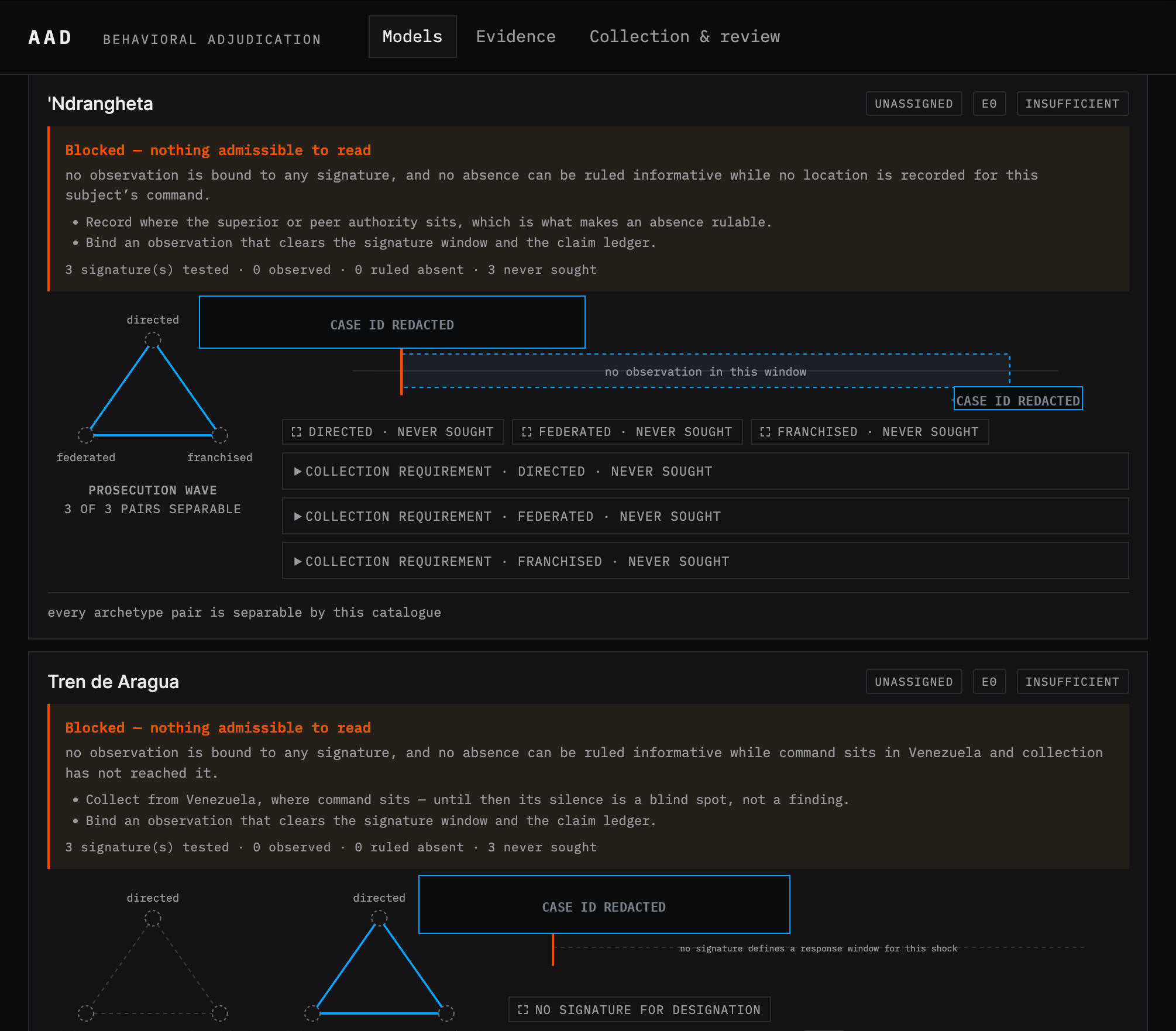
The adjudication interface itself. Case identifiers and exact shock dates are redacted for this public view; the underlying verdicts and evidence counts are shown as recorded.